
Porsche Track Experience – Introductory Experience
As GGR’s treasurer, I don’t normally contribute to our Nugget—credit, debit, and bank balances don’t make for enticing reading. This time, though, I had the opportunity to attend Porsche Track Experience’s two-day Introductory Performance class at the iconic WeatherTech Raceway Laguna Seca. The course is geared toward drivers with little or no track experience.
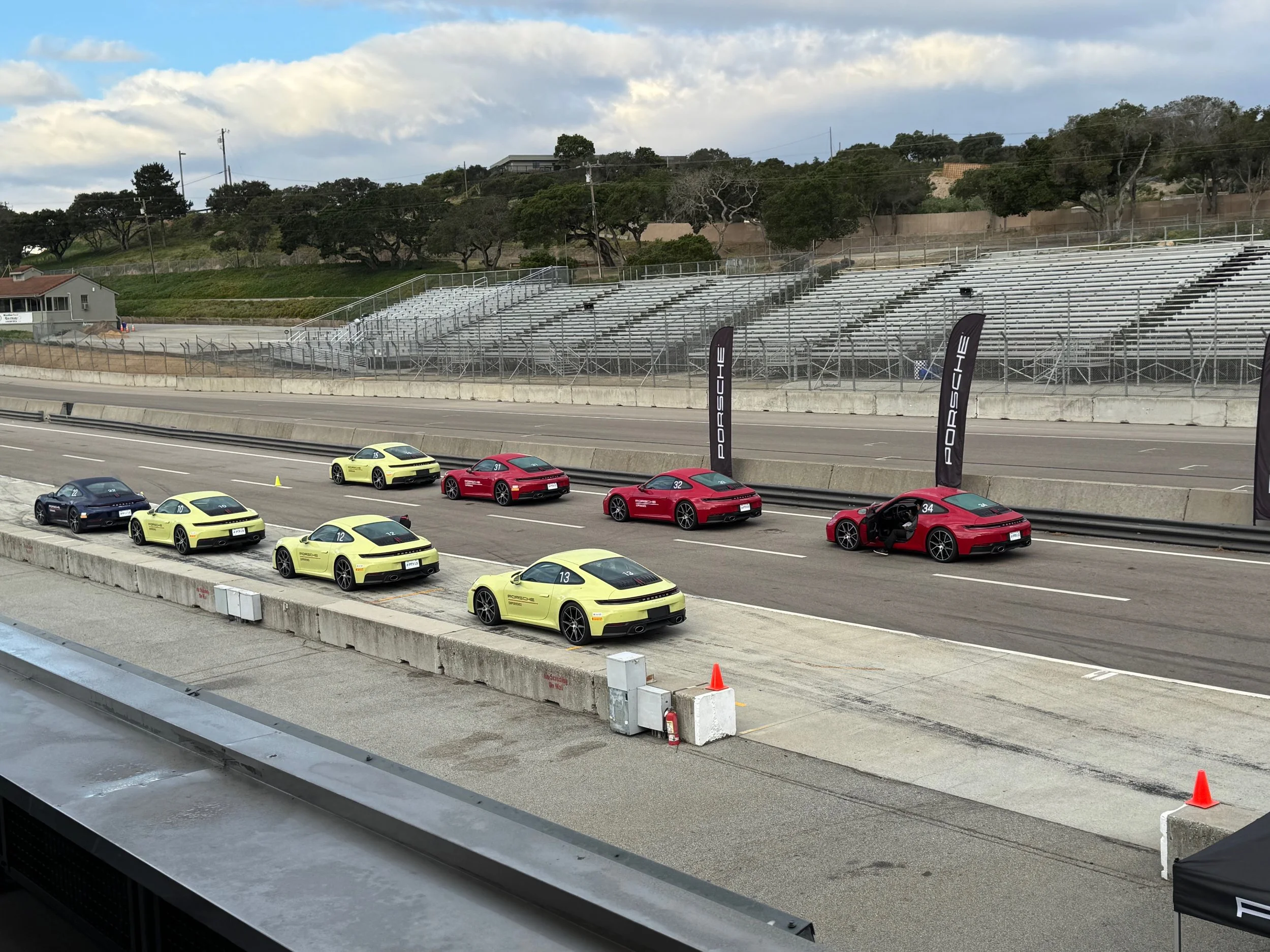
Our class had 25 attendees. Students are typically split into six groups (usually four per group, though mine had five), so I suspect the normal cutoff is 24. Each day followed the same sequence: about an hour on track and an hour of off-track exercises in the morning, then the same again in the afternoon. The student-to-instructor ratio was excellent—one instructor per group on track and two instructors per group for the off-track exercises—plus a head instructor who led the classroom sessions and floated as needed.
In the morning, three groups headed to the track while the other three took shuttle vans to the Laguna Seca lakebed for off-track exercises (the Golden Gate Lotus Club uses the same lakebed for some autocross events). After lunch, the groups swapped. We repeated the same rotation on Day Two.
During track sessions, each set of three groups was subdivided again into four packs of three drivers, based on prior track, autocross, or other high-performance driving experience. All four packs ran simultaneously in lead-follow format: an instructor out front, with three student cars following behind in assigned cars.
For the exercises, we drove a 718 Cayman GTS and a 992 911 S; on track, we were in 992 911 S cars. The cars were stock but equipped with PCCBs. I forgot to ask whether they ran a track alignment.
Both days included catered breakfast and lunch, with good options for both carnivores and vegetarians. Snack and water stations were set up at each off-track exercise location and at the track, and restrooms were easy to access at both the lakebed and Laguna Seca. Dinner at the host hotel—InterContinental The Clement Monterey on Cannery Row—was included in the two-day package.
With the logistics out of the way, here’s what stood out most—both in terms of driving technique and the overall experience.
I’ll save the blow-by-blow of each day’s exercises for later in this post. First, here are my biggest takeaways from the two-day Porsche Track Experience.
The instructors were friendly, professional, and genuinely eager to answer questions. The students were just as fun to be around—learning from one another and helping each other improve. Between the coaching, the camaraderie, and the chance to drive at speed on an iconic track (including the famous Corkscrew), the two days flew by. It’s an experience I’d happily repeat by taking the intermediate-level Porsche Track Experience. Yes, it was worth the price of admission.
Driving on track was an absolute blast, and I didn’t expect to feel as comfortable at speed as I did. There weren’t any “oh-crap” moments, which I credit to the lead-follow format and my prior autocross experience. The scariest moment at first was cresting the blind downhill into the Corkscrew—also the most exhilarating.
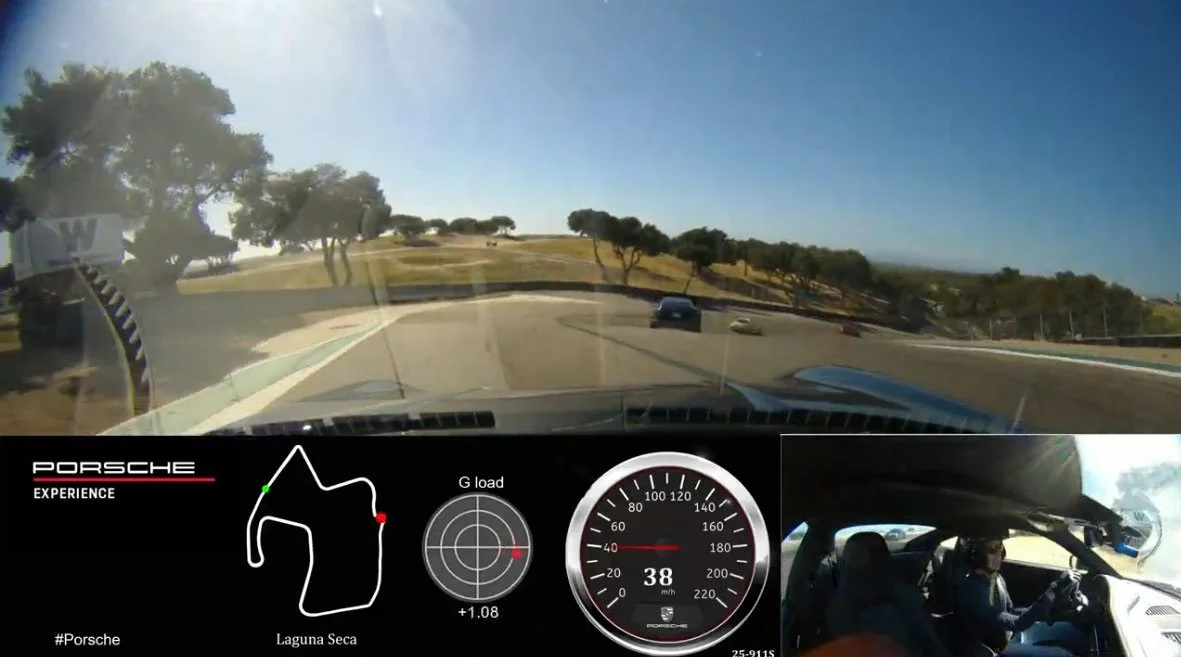
Surprisingly, turns 3 and 4 gave me the most trouble; I occasionally pushed wide and even clipped the track-out marker cone on one run (another student in our group had the same issue). When I mentioned it, my instructor said he also finds those turns tricky. His theory was lower grip from dirt and debris, and he recommended using a later apex line.
Unlike autocross, track driving gives you time to feel what the car is doing under sustained load—and how to use those G forces to your advantage. The speed is addictive. My biggest personal takeaway was trail braking. In lead-follow, you can watch exactly how the instructor brakes into a corner and how long they stay on the pedal as they turn in. My instructor clearly trails off the brakes deeper into the corner than I typically do in autocross. The idea is that if you trail brake farther into turn-in, you can carry more speed on entry, because you’re not doing all of your deceleration before you start steering. On track, that often means a hard initial brake hit, followed by a longer, smoother release to manage weight transfer onto the front tires. Laguna Seca is a great place to work on this because it has a mix of corners—some needing heavy braking, others just a brush of the pedal to settle the nose.
I suspect I got more out of Porsche Track Experience than the typical attendee because of my autocross background. It’s hard for someone brand new to performance driving to process the sheer volume of information coming at them—track layout, visual reference points, braking markers, steering inputs, instructor feedback, and what the car is telling you—all at once.
If you want a taste of driving on track but don’t plan to pursue track days, autocross, or other high-performance driving activities, you’ll have a wonderful time in either the two-day Performance or one-day Precision Track Experience.
If you already have performance-driving experience and want to improve, you’ll get a lot out of the two-day Performance Track Experience. The instruction, exercises, and lead-follow track time reinforce fundamentals, and then allow you to hone and refine your technique.
My notes from the day’s lessons
Groups: Groups 1–3 started the morning with track driving; groups 4–6 started with the exercises. I was in Group 6 and from a learning perspective, driving track after the exercises was ideal.
Day 1 (4/1/25)
Classroom: Circular vs. late-apex driving lines; hard braking in a straight line before turn-in; trail braking; and the friction circle (if the car is at maximum braking, adding steering input won’t make it turn). One analogy: tie a string between the steering wheel and either the brake or gas pedal—adding steering input “pulls up” on the pedal, reducing brake/throttle input.
Morning (Lakebed): 3 exercises with at least 2 instructors per exercise providing immediate feedback and coaching.
Threshold braking ending in an abrupt turn-in, to teach easing off the brakes enough to make the turn. This is the hardest I have ever braked, even on an autocross course. Recommendation: don’t wear track shoes with thin soles—the ball of my right foot now has a permanent indentation in the shape of the brake pedal. Cayman GTS with PCCBs.
Figure eight to practice trail braking, minimal braking into the turns, rolling onto the throttle smoothly at exit, and generally smooth inputs. Cayman GTS with PCCBs.
Low-friction skid pad flooded with a constant flow of water, to practice correcting understeer by reducing throttle while driving a circular path marked by cones. 911 S with PCCBs.
Afternoon (Lakebed): 3 exercises.
Four-cone, equal-distance slalom. Goal: lift before turn-in, then accelerate out to feel weight transfer from front to back (counter to what I normally do in a slalom, where I hold a more constant speed). Cayman GTS with PCCBs.
Short, tight AX course (shaped like half of a dog bone sliced lengthwise). Goal: trail braking and unwinding the steering wheel while accelerating out of the two dog-bone 180s. The three main braking points were marked with cones. Cayman GTS with PCCBs.
Low-friction skid pad to practice correcting oversteer by reducing throttle and adding countersteer. Hardest exercise of the day—speed and the amount of countersteer were both critical. 911 S with PCCBs.
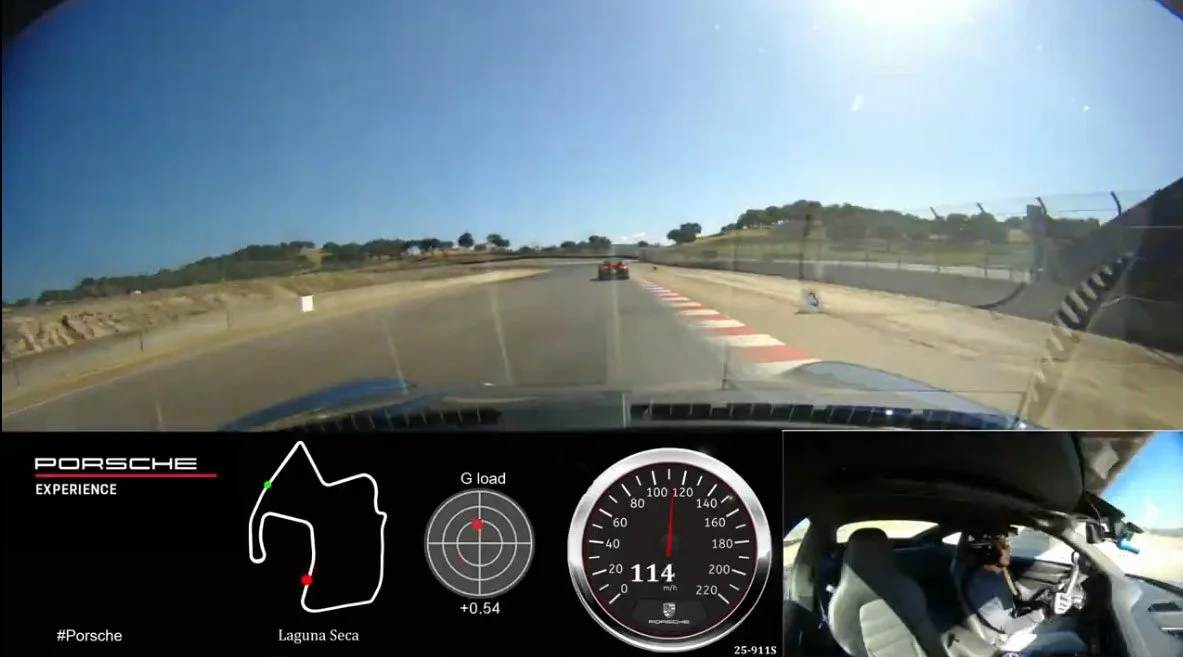
Track time: 911 S with PCCBs, morning and afternoon sessions. Best part of the day. Three of the six groups were on track at any time.
Lead-follow format with only three cars following, equipped with walkie-talkies for instructor input. Student cars rotated positions frequently after several laps, so everyone had the benefit of running directly behind the instructor.
Data logging: we were given a USB thumb drive to plug into the cars on track. The car recorded two videos (one out the windshield, one on the driver) with a G-meter and speed overlay. Racelogic VBOX data was also included.
We started out slow to learn the course.
Braking zones were marked by trackside signage for turn-in, followed by three numbered cones (3, 2, 1) deeper into the braking zone.
Green cones marked turn-in, apex, and track-out points. These were critical for me to correctly enter a turn. The instructor constantly reminded us not to fixate on the rear bumper of the car in front of us—otherwise you’ll never learn the track. At corners, that was difficult to avoid because I was worried about running into the car ahead in the braking zone.
Afternoon session: I hit at least 125 mph on the main straight approaching Turn 1.
At the end of Day 1, we had the option of a ride-along with instructors, who drove at about 70% to give students a sense of how it’s done. The goal was to show how smoothly you should transition from trail braking to rolling onto the throttle. We were told that, when it’s done right, you shouldn’t be able to detect the exact moment that transition happens.
The school found that doing a ride-along before students had a taste of driving on track gave some students the wrong impression (that they could drive like this on their first run), which likely led to some interesting off-track excursions.
Day 2 (4/2/25)
Day Two was essentially a repeat of Day One, with the goal of honing and polishing our on-track skills, plus a couple of changes to the off-track exercises. Autocross replaced the previous day’s morning figure-eight, and a figure-eight course on the skid pad replaced the drift circle.
Classroom: Static vs. dynamic friction (tire grip), with a graphic showing maximum initial braking followed by trailing off.
Timed autocross in the afternoon: individual times for three laps, plus a team total time that included the time it took to switch drivers. Awards were given at the end of the day for the fastest driver and fastest team. I hit a cone on my last lap for a 2-second penalty, which ended my chances of a top-time-of-day result.
Timed figure-eight skid pad in the afternoon over three or four laps. Award given to the fastest driver.
At the end of Day 2, we again had the option of a ride-along with instructors, but this time they were driving at 100%. It was eye-opening to see how relaxed my instructor was at speed. He was willing to answer my questions about technique while he was moving—and it didn’t feel like he was moving, because his inputs were that smooth.
Best,
Alan Jung
GGR Treasurer
#PTXLS