
Porsche Track Experience, Round Two: PTX Masters Class
I had such a great experience in early April 2026 attending Porsche Track Experience’s (PTX) 2-day Performance course at Laguna Seca (see my earlier write-up here), I splurged on their follow-up intermediate 2-day Masters course, the second of three sequential driving courses held at Laguna Seca. Plus, I brought along my friend, Steve Forshay, autocross director of PCA Golden Gate Region.
Why the Masters Course Feels Different
The overall structure is familiar: two days split between classroom instruction, lakebed exercises, and on-track sessions, with the same high standard of instructors, facilities, meals, and organization that made the Performance course so memorable. Breakfast and lunch were catered, and the first day concluded with an included dinner at the host hotel, InterContinental The Clement Monterey.
The real difference was the track format. Performance relies heavily on instructor-led lead-follow driving. Masters still begins that way, but the class quickly moves students into open track sessions, where the instructor is no longer a rolling reference point. That change transforms the experience. Instead of copying the car ahead, I had to remember braking points, look farther ahead, identify turn-in and apex references, manage traffic, and make decisions at speed.
Participation was limited to approximately 24 students organized into six groups of four, although our class was slightly smaller. In the morning, 3 groups were assigned to the lakebed exercises and the other 3 to the track, then switched positions halfway through the morning. The afternoon followed the same pattern.
The lakebed exercises repeated the PTX Performance format, but the repetition was valuable rather than redundant. Threshold braking, trail braking, understeer correction, and oversteer correction all improve with seat time, and the controlled environment made it possible to practice mistakes safely
The track sessions began with lead-follow laps to reacquaint us with Laguna Seca’s rhythm and reference points. There were 4 groups, consisting of 3 cars each, on track at any time. Our 992.2 911 Carrera S with PDK and PCCB were equipped with walkie-talkies for instructor input. Students were given a USB thumb drive to record telemetry and videos (one out the windshield, one on the driver) with a G-meter and speed overlay. Unfortunately, my USB drive failed to record my open track session on day 1 and all of day 2. A good excuse to return to Laguna Seca for the advance PTX Masters RS course. Student cars rotated positions after several laps, so everyone had the benefit of running directly behind the instructor. Day 1’s morning session was lead-follow, while the afternoon session was open track, where drivers were on their own to negotiate their way around the track. Day 2’s morning and afternoon sessions would have been open track, but the morning session was replaced by lead-follow because the track was wet from overnight showers.
Following an instructor around track was challenging but comparatively straightforward and reminiscent of my PTX Performance experience. The instructor’s car provided speed, driving line, braking, and acceleration references. Driving open track was much more demanding, but also far more thrilling and rewarding. I was on my own, relying on memory, rather than simply sticking to my instructor’s rear bumper. This made it essential to look ahead, identify braking and turn-in points early, and recall the full sequence at speed.
The PTX Masters was well worth the price of admission. The driving instruction was excellent. The instructors are current or former professional race car drivers, including the last American to win the 24-hours of Le Mans. They were professional, friendly, accommodating, and genuinely interested in helping you to excel. My fellow students were awesome. Great comradery, helping one another, while sharing our life’s stories. And then there’s Laguna Seca Raceway with its iconic corkscrew. What’s not to like.
Left the course more confident, but also more aware of how much precision matters at speed. The Masters course did not just give me more laps; it made me responsible for those laps. That is the real value of the program.
My notes from the day’s lessons
Day 1 (8/26/26) Morning Classroom – repeats most of the material included in PTX Performance class.
Friction circle: steering has minimal effect at maximum braking because tire grip is already fully committed to braking.
String theory: steering input has an inverse relationship with brake and throttle input; increasing braking or throttle requires reducing steering input, and vice versa.
Weight transfer: Loading the front or rear tires is managed through brake and throttle application. Braking transfers weight to the front tires adding turn-in grip, while rolling onto the throttle transfers weight rearward for added rear grip and reducing oversteer.
Trail braking: Begins with threshold braking, then progressively releasing brake pressure toward roughly the apex. Threshold braking is maximum braking, without engaging ABS. This keeps the front end planted, improving turn-in, and reduces understeer, which is especially important for rear weight biased 911s.
CPR correction: Understeer and oversteer management follows the sequence of Correction, Pause, and Recovery.
Apex strategy: Constant radius requires constant speed, while variable radius requires a late apex with slow in and fast out.
Early apex risk: An early apex points the car toward the outside of the track too soon, rather than down the track at corner apex. Rolling on the throttle compounds the problem.
Flags and passing: Track flags were reviewed with emphasis on both meaning and required driver response. Open track passing was limited to four designated zones, the straights between turns 11 and 1, turns 4 and 5, turns 5 and 6, and turns 6 and 7. Passing only on the left, and only when a point-by signal (i.e., lefthand turn signal) is received from the driver being passed.
Safety: Safety remained the highest priority throughout all classroom, lakebed, and track sessions.
Day 2 (8/27/26) Morning Classroom
Trail Braking Sequence: threshold braking zone, trail-braking zone, turn-in, apex, throttle application, and track-out. Trail brake to about 1 car length before the apex, then roll on the throttle.
Braking Pressure: Use strong initial braking to initiate weight transfer, then modulate pressure. Soft initial braking followed by added pressure produces less effective weight transfer.
Elevation Changes: Elevation changes affect grip: uphill compression increases traction and can shorten braking zones, while downhill sections reduce traction and often require later turn-in with an extended braking zone.
Corner Entry: Fast corners require slower hands and smoother steering inputs. Slow corners, such as Turn 6, require quicker hands and more immediate steering input.
Speed and Grip: Shed speed early rather than later. Higher speed increases inertia and can create additional grip through weight transfer, but only when inputs remain smooth and balanced.
Lakebed Exercises – identical to the ones in the PTX Performance class.
Day 1 (8/26/26) Morning
Braking Box Lesson: maximum braking without engaging ABS, i.e., threshold braking. Cayman GTS with PDK and PCCBs.
Braking Box with right-hand turn: reinforced the friction circle by demonstrating the car will not turn effectively while tire grip is fully committed to braking; easing brake pressure frees grip for steering. Cayman GTS with PDK and PCCBs.
Autocross figure-eight: practiced trail braking toward each 180-degree apex, using firm initial braking to transfer weight forward and reduce understeer at turn entry. Cayman GTS with PDK and PCCBs.
Wet skid pad: Understeer correction by lifting off throttle, which shifts weight forward to increase grip. Light braking increases weight transfer even more. 911 Carrera S with PDK and PCCBs, all nannies (i.e., PSM) turned off, and over inflated tires.
Day 1 (8/26/26) Afternoon
Slalom: practiced transferring weight front-to-rear by lifting before each cone, turning in, and accelerating toward the next cone; instructors noted this approach was faster than maintaining constant speed. Cayman GTS with PDK and PCCBs.
Autocross on a half dog bone: Lesson: trail braking through a decreasing radius 180-degree turn. Cayman GTS with PDK and PCCBs.
Wet skid pad: practiced oversteer correction through counter steering and quick steering inputs, with emphasis on decisive correction in the direction of the skid. Carrera S with PDK and PCCBs, PSM turned off, and over inflated tires.
Day 2 (8/27/26) Morning
Braking Box and Braking Box with right-hand turn: reinforced threshold braking, brake release, and the need to free tire grip before adding steering input. Cayman GTS with PDK and PCCBs.
Timed autocross on half dog bone course: completed five sessions of three laps, with a two--second cone penalty and a ten-second stop-box penalty during driver changes. I failed to come to a full stop in the stop box, which was a useful reminder that precision and procedural discipline under time pressure matter as much as pace. Cayman GTS with PDK and PCCBs.
Wet skid pad: drove a figure-eight course at increasing speed to combine understeer and oversteer correction skills. This was technically challenging and a high-engagement exercise. Carrera S with PDK and PCCBs, PSM turned off, and over inflated tires.
Day 2 (8/27/26) Afternoon
Students were positioned at Turns 2 and 5 to watch our classmates negotiate open track, focusing on racing lines, braking zones, trail-braking zones, and corner transitions while instructors provided critique. Very educational.
Day 1 (8/26/26) Track Time
The two morning sessions were lead-follow format, with the instructor demonstrating the correct entry line, braking point, trail-braking release, turn-in, throttle roll-on, and track-out. Like the PTX Performance course, track lessons were limited to at most twelve cars with four instructor led groups leading three cars (911 Carrera S with PDK, PCCBs and PSM turned on). I was fortunate to be in a two-car group with Steve, which meant frequent time directly behind the instructor. On track, printed signs were placed at the corner entry to mark the start of each braking zone, followed by three numbered signs counting down from 3 to 1 approaching corner apex. Cones were placed to mark corner turn in, apex, and track out points.
The first afternoon session began with a ride along with an instructor, who provided his recommendations on driving lines, reinforcing the lessons on corner entry and exit from the morning’s lead-follow sessions. My instructor also provided visual cues moving his right forearm to mimic throttle and brake application, showing how quickly he applied initial brake pressure and how smoothly he released into trail braking. He was doing this while driving at 7 tenths, which was quite impressive. As we approached the pit lane, he turned to me to emphasize his initial braking into corners was rapid and hard, followed by modulating into trail braking. The purpose was to initiate immediate weight transfer to the front tires to increase their grip and aid in initial turn in and minimize understeer. That demonstration made the classroom concept concrete. The next session was lead-follow with a different instructor, who demonstrated the correct driving line by slowly traversing each corner, while announcing over the radio the appropriate driver inputs for taking a corner. This was reinforced by the instructor flashing of his brake lights to signal the start and end of braking. Next, we were let loose on the track for our first open track experience, with instructors stationed at each corner to observe our technique. When we came off track, we met with each corner instructor for feedback. The first open track session was a disaster, 14 drivers received black flags for numerous violations. I was black flagged for braking too late coming into corner 11. I guess the corner instructor heard me engaging ABS and my tires complaining. The lead instructor admonished us for our driving indiscretions and then sent us back out on track for our second sessions. We heeded his words and no black flags were thrown. We received praise from the lead instructor for our improvement.
Day 2 (8/27/26) Track Time
The morning session were lead-follow rather than open track because the track was damp from overnight rains. Steve and I were fortunate to have Davy Jones as our lead-follow instructor, who is the last American to win the 24 hours of Le Mans. His instructions and driving hints were superb, enhanced by his friendly and calm personality. The afternoon sessions were open track. Everyone improved on their driving from the previous day, with average track speeds increasing. No one received a black flag.
Laguna Seca Corner Notes
Turn 1 and Turn 2. Top of hill. Sight 4 power poles behind Turn 2. Aim for the 3rd left most one. Stay track right, brake hard, start late apex. Take turn as a single apex. You should be parallel to 1st apex about a half to a car’s width away from the inside curb. Rotate steering wheel to turn left and hold the position until passing 2nd apex – advice from Davy Jones. Trail off brakes about 1 car length before 2nd apex. Exit the white portion of the 2nd apex curb. Should not need additional steering input until unwinding. Track out to the right, then full acceleration by the track-out cone while aiming for #1 brake sign on Turn 3. This will naturally place your car at the outside entry into Turn 3.
Turn 3 and Turn 4. Late apex. Delay turn in until white painted section of left-hand curb.
Turn 5 and Turn 6. Give up speed to get back on the gas just prior to apex. Trail brake to within 1 car length of the apex. Turn 6 allows earlier throttle application because compression and uphill track-out add grip.
Turns 8 and 8A, The Corkscrew: Use medium brake pressure transitioning from the painted white section at the end of the left-hand curb to the right of the track going into Turn 8. Turn in with trail brake, back on gas and briefly straightening the car downhill, aim for the middle of 3 trees behind Turn 8A, then rotate right down the track. Track out to the left and aim for flag station to the right of Turn 9. This will position your car from track out left to the middle of the track.
Turn 9: Use light brake into the turn, not to slow, but to transfer weight forward.
Turn 10: High speed turn with track camber assisting turn in. Inputs should be smooth and deliberate.
Turn 11: Begin braking early and firmly at the brake sign. Trail brake to just before the apex, roll onto the throttle, track out to the green pavement to the right of the exit curb, and aim for full throttle by the track-out cone.
Alan Jung
Treasurer, Porsche Club of America - Golden Gate Region
#PTXLS
Photos provided by PTX. https://porschetrackexp.eventgallery.com/gallery/laguna-seca-ptx-masters-course-8-27-28-26. Relevant photos below.
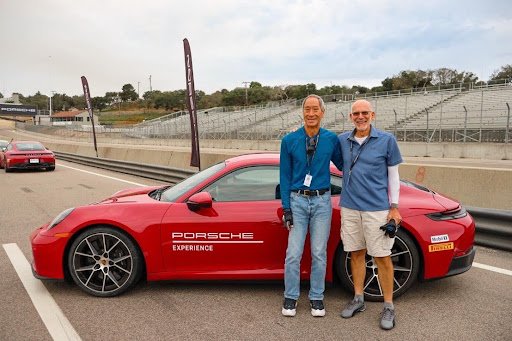
Photo: PTX
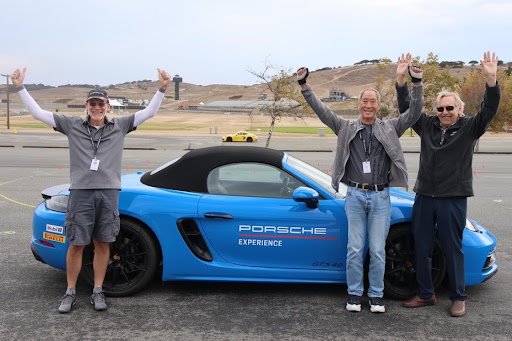
Photo: PTX
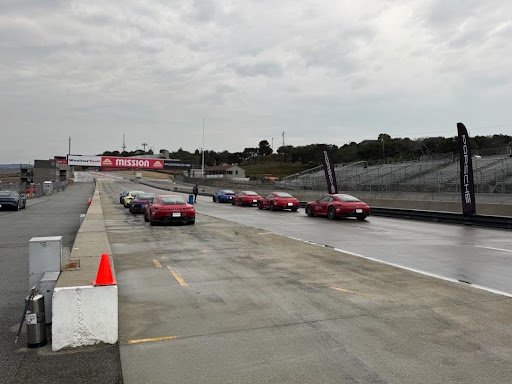
Photo: PTX
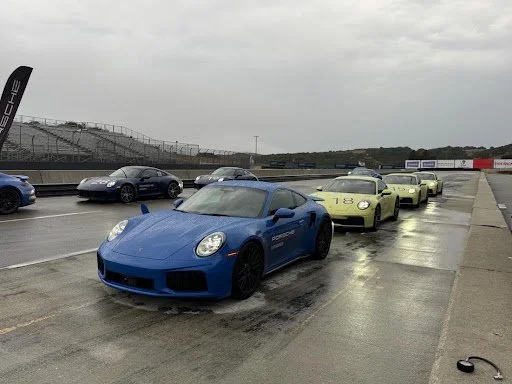
Photo: PTX
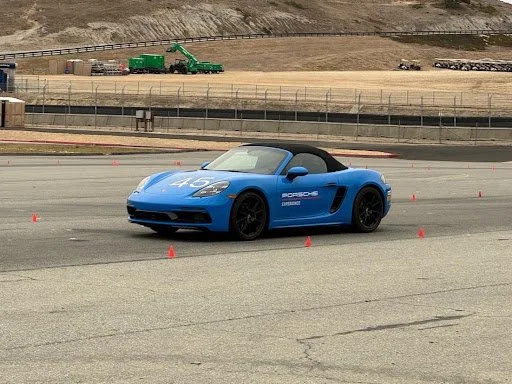
Photo: PTX
Alan on the wet skid pad courtesy of Steve Forshay
https://drive.google.com/file/d/1_9B0x4OSy8bHf3Z-KNZ-uzIdlmchdjIs/view?usp=sharing